The Blacksmith
Temper, Upgrade Base, Salvage and Repair — costs, the base-upgrade sacrifice, salvage odds, and rarity-based craft timers.
On this page
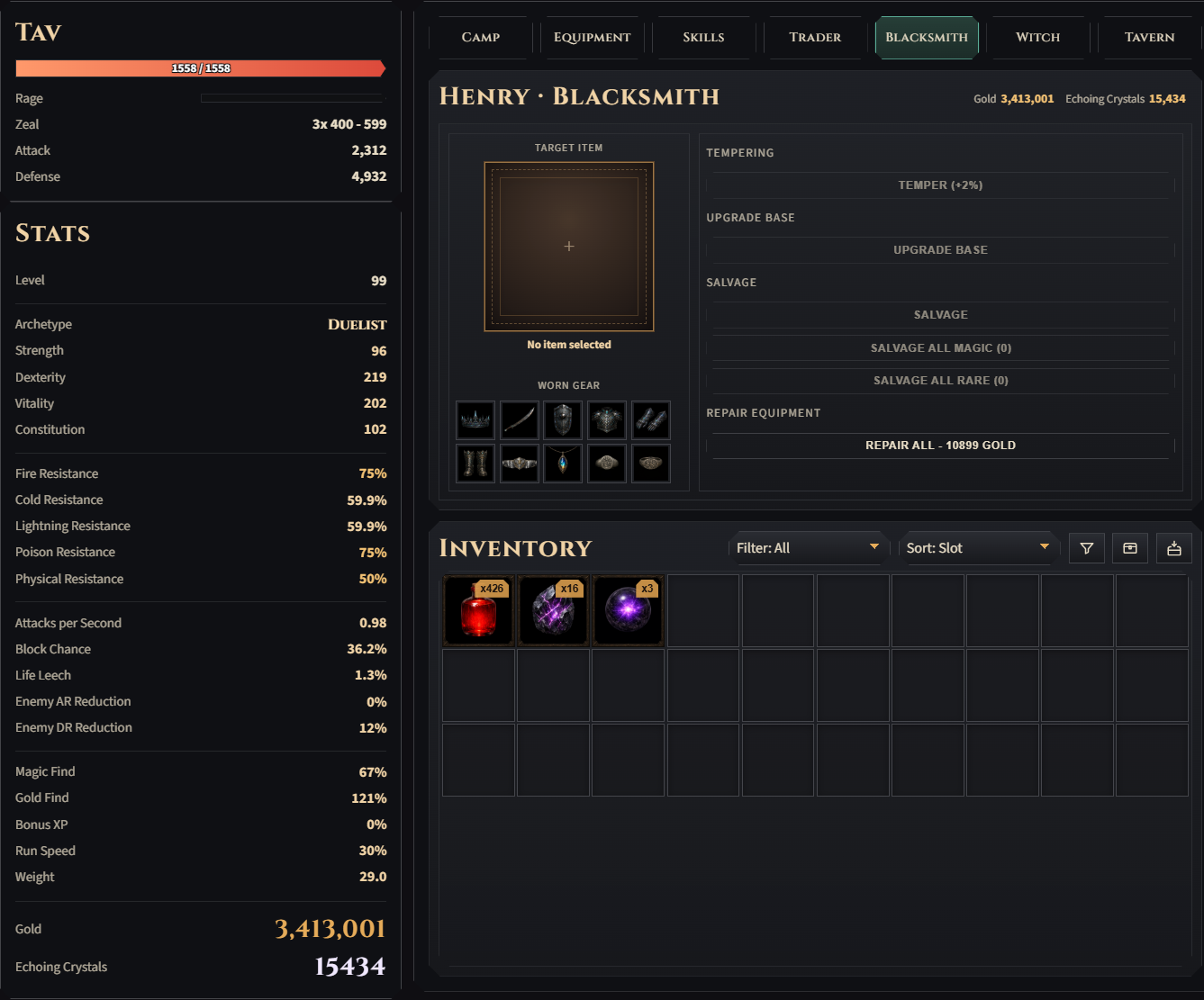
Henry works the item itself, not its affixes — those belong to the Witch. Pick a target item (equipped items count; you never have to take your gear off) and choose:
- Temper — adds +2% to the item’s base stats per step, up to 10 steps (+20%). Costs Echo Shards.
- Upgrade Base — reforges the item onto the same family’s next-tier base. Costs Echo Cores plus one sacrificed base item.
- Salvage — instantly destroys a Magic, Rare or Unique item for crafting materials. A gamble, and the game’s main material source. No fee, no timer.
- Repair — restores durability. Gold-only and instant, on one item or on everything equipped.
Temper and Upgrade Base are commissioned in place: the item stays where it is — including on your hero, fully usable — while the smith works, and the result applies to it when the timer elapses. The lock scales with rarity (Magic = 2 h, Rare = 4 h, Unique = 8 h), keeps counting down while you’re offline, and the exploration skill Forge Mastery shortens it. One commission at a time — Salvage and Repair need no smith time and stay available while he works; the piece on his anvil itself is the one thing he refuses to salvage until it’s done.
Upgrade Base
The reforge needs a sacrifice: one normal-rarity, unmodified copy of the target base, in your bag or stash. (Jewelry — amulets and rings — has no normal-rarity base, so any non-unique copy of the target base qualifies instead — the cheapest one is consumed.) It is eaten the moment you commission the work.
What carries over to the new base: all affixes, every temper and enchant step, and the rarity. The item comes off the anvil at full durability, and its level requirement follows the new base — if that outgrows your hero, the item is unequipped for you. Tier-5 bases can’t be upgraded further.
Because an affix can never out-tier its host item, upgrading the base is also what raises the ceiling for the Witch’s Upgrade Affix Tier.
Salvage
Salvage destroys the item on the spot — no gold cost, no lock — and rolls a success chance by rarity. On a success you get materials; on a miss the item crumbles to Echo Dust worth 7.5% of its value (sellable, no crafting use).
| Rarity | Success chance | On success (by item tier 1→5) |
|---|---|---|
| Magic | 25% | 1 / 1 / 2 / 3 / 5 Echo Shards |
| Rare | 30% | 1 / 2 / 3 / 5 / 8 Echo Shards, plus a 10% chance of 1 bonus Echo Core |
| Unique | 50% | 1 / 1 / 2 / 3 / 4 Echo Cores |
Normal items are not salvageable — they are base-upgrade fodder (and vendor gold). Salvage only reaches items in your bag: locked items, game-master items and anything an artisan is working on are refused, and equipped or stashed gear has to be moved to the bag first.
Two bulk buttons — Salvage all Magic (n) and Salvage all Rare (n) — sweep every eligible item in the bag; each rolls its own gamble, and locked / in-work items are skipped.
Costs
| Service | Material | Gold formula |
|---|---|---|
| Temper | Echo Shards | (1000 + ilvl × 180) × rarityMult |
| Upgrade Base | Echo Cores (at the target tier) | (4000 + ilvl × 300) × rarityMult |
| Salvage | — | free |
| Repair | — (gold only) | missingDurability × ilvl × 3 |
Material amounts scale with the item’s tier: 1 / 2 / 4 / 8 / 16 Shards or Cores for Tier 1
through Tier 5; uniques pay 2×. Rarity gold multipliers are Magic ×1.15, Rare ×1.35, Unique ×1.75.
On tier-5 items — and on any upgrade into tier 5 — the gold fee is replaced by Echoing
Crystals (ceil(gold ÷ 10), minimum 1); Repair is not a craft fee and always stays gold. Bedroom
Cost Reduction and the Master Craftsman exploration skill both cut the gold cost.
See Currencies & Crafting Costs for the full material table, cost reductions, and a worked example.